

Dozens of farmers from Changhua County’s Sijhou Township (溪洲) yesterday protested outside the Environmental Protection Administration (EPA) and submitted a petition asking it to investigate the construction of an aqueduct to supply water to the Central Taiwan Science Park.
The protesters questioned the legality of the project, saying no environmental impact assessment (EIA) had been performed before construction got underway.
Standing under the baking hot sun, farmers held up placards and chanted slogans calling on the EPA to intervene and put a stop to the project.
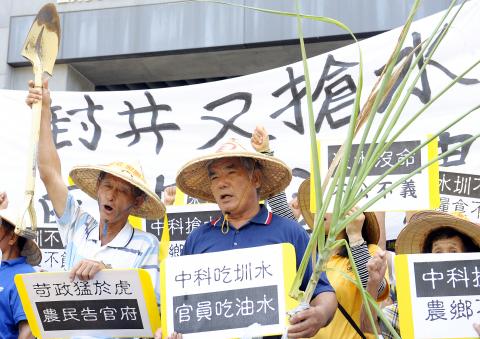
Photo: George Tsorng, Taipei Times
“The project is to build an aqueduct to deliver water from the a local irrigation channel called Cijhaipijun (莿仔埤圳) to the park’s Erlin (二林) campus” in Changhua County, said Lu Shih-wei (陸詩薇), an attorney representing the farmers.
She said that, as part of the construction, the digging of a 13 hectare lake had already started.
“According to the law, an EIA must be conducted prior to construction that involves a site larger than 10 hectares, but no EIA was performed prior to construction, therefore it’s illegal and the EPA should call a halt to construction,” Lu said.
Lu said the Water Act (水利法) stipulates that agricultural activities should take the priority in the allocation of water resources, “which means that water can only be supplied for other uses when the demand for agricultural use is satisfied — which is not the case at all.”
Hsieh Pao-yuan (謝寶元), one of the farmers at the rally, supported Lu’s remarks.
“Currently, water only comes through irrigation channels for four days in every 10. It’s really not sufficient and every farmer needs to dig water wells so that demand can be fully satisfied,” he said. “Now that some of the already scarce water is to be used by the science park it’s going to kill the agricultural businesses in the area.”
Another Sijhou farmer, Sung Ching-hsing (宋清興), said that although the aqueduct starts in Sijhou, the construction would have an impact on the entire southern half of the county as the irrigation systems are all connected.
“Water for irrigation became insufficient more than a decade ago, when a large amount of water from the Jhuoshuei River (濁水溪) was sent directly to the Formosa Plastics oil refinery complexes in [Yunlin County’s] Mailiao Township (麥寮),” Sung said. “Now that more water is going to the science park, how are we going to survive?”
“This is a pig-headed government implementing pig-headed policies,” he added.
An EPA official, Yeh Chun-hung (葉俊宏), accepted the petition from the farmers and promised to launch an investigation.
“We will look into the issue and see if the construction is in violation of the Environment Impact Assessment Act (環境影響評估法) and will officially reply within 60 days as the law stipulates,”Yeh said. “If the violation is confirmed, we will order that construction be terminated and the park will be fined between NT$300,000 and NT$1.5 million [US$52,000].”
When asked why the EPA had not taken the initiative and launched a probe earlier — as it was not the first time the farmers had protested about the construction — Yeh said according to the law, the EPA starts the process upon receiving a petition.
“We cannot [start a probe] just because newspapers report on it,” Yeh said.
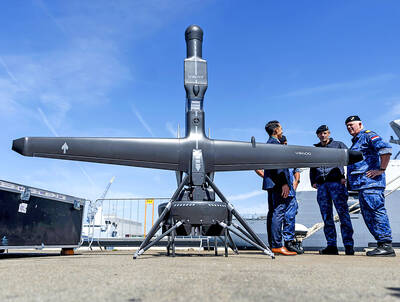
DEFENSE PROCUREMENT: Taiwan could become the largest operator of V-BAT drones outside the US once they are delivered, the Ministry of National Defense said The navy and the coast guard are acquiring 292 units of MQ-35A V-BAT vertical takeoff and landing (VTOL) surveillance drones manufactured by US-based defense technology company Shield AI, making Taiwan one of the largest buyers of the drone. The Coast Guard Administration budgeted NT$1.2 billion (US$37.1 million) to buy 12 drones, which have been delivered, Shield AI said in a report on Oct 13. The navy is planning to spend NT$36 billion under a four-year program code-named Project Yuan Xiao (遠鴞) to acquire 280 V-BAT drones, the Ministry of National Defense’s fiscal 2027 report showed. The combined procurement is expected
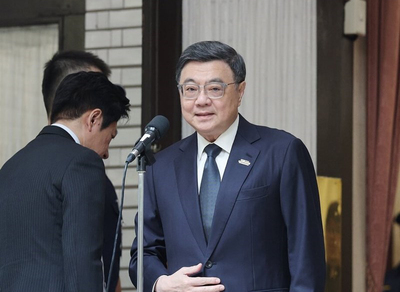
The government would continue monitoring online rumors that a pneumonic plague outbreak has spread from Russia into China and could enhance existing quarantine measures, Premier Cho Jung-tai (卓榮泰) said today. During a legislative meeting, Democratic Progressive Party Legislator Wang Ting-yu (王定宇) said rumors were circulating that the disease had spread across several Chinese provinces. He asked Cho whether the government was prepared to prevent the disease from spreading to Taiwan, given the frequent exchanges between Taiwan and China, and how concerned the government was about the alleged outbreak. The Ministry of Health and Welfare implemented border quarantine measures after briefing the Executive Yuan

MAYORAL RACE: Su Chiao-hui made gains by persuading undecided voters and winning over voters in KMT-leaning districts, a pollster said Legislator Su Chiao-hui (蘇巧慧), the Democratic Progressive Party’s (DPP) candidate for New Taipei City mayor, has a 13.1 percentage point lead over her Chinese Nationalist Party (KMT) rival Lee Shu-chuan (李四川), a poll released yesterday showed. The poll, commissioned by the Taipei Trust in Democracy Association, showed that 43.1 percent of respondents said they would vote for Su, up 7.9 percentage points from a poll conducted in late August, while support for Lee was at 30 percent, down 4.7 percentage points. It showed that 48.6 percent of respondents thought Su would make a suitable mayor, compared with 35.9 percent for Lee. Independent candidate
A Chinese People's Liberation Army (PLA) Navy aircraft carrier group was being monitored after entering the western Pacific, the Ministry of National Defense said today, after Beijing yesterday criticized Taiwan for using a water cannon against a Chinese fishing boat near the Pratas Islands (Dongsha Islands, 東沙群島). A Chinese naval task group led by the aircraft carrier Liaoning (遼寧) yesterday sailed to the western Pacific for training, Chinese state-run Xinhua news agency quoted the PLA Navy as saying. “The drill is part of the annual routine training plan aimed at testing and improving the troops’ combat readiness and enhancing their ability to


 RSS
RSS